A. Fill in the blanks.
- All living organisms are made up of cells.
- The cell wall provides rigidity and protection to the plant cell.
- All cellular activities are controlled by the nucleus.
- The mitochondria is known as the powerhouse of the cell.
- Tissue is a group of cells performing a specific function.
- It was Robert Hooke who observed cells for the first time.
C. Tick (✓) the correct option.
1. The cell organelle, which acts as a storage bag for a cell, is known as the—
(a) chloroplast
(b) chromoplast
(c) mitochondria
(d) vacuole ✓
2. Hen’s egg is—
(a) a cell organelle
(b) a tissue
(c) a single cell ✓
(d) an organ
3. The nucleus is separated from the cytoplasm by the—
(a) cytoplasm
(b) nuclear membrane ✓
(c) cell membrane
(d) protoplasm
4. Which of the following will not be found in an egg cell, human liver cell and an Amoeba?
(a) ribosomes
(b) cell membrane
(c) mitochondria
(d) cell wall ✓
5. Which of the following represents the correct sequence?
(a) tissue → cell → organ → organ system
(b) organ → tissue → organ system → cell
(c) cell → organ → tissue → organ system
(d) cell → tissue → organ → organ system ✓
6. Which, amongst the following pairs, can be found only in a plant cell but not in an animal cell?
(a) cell wall and plastids ✓
(b) plastids and cilia
(c) cell wall and cell membrane
(d) plastids and mitochondria
D. Answer the following questions in brief.
1. List the (main) factors that determine the shape of a cell.
The shape of a cell mainly depends upon its function, location and the work it performs in the body. Different cells have different shapes because each cell is designed to perform a particular task efficiently. For example, nerve cells are long and branched to carry messages, while red blood cells are round and flat to transport oxygen easily.
In plant cells, the presence of a rigid cell wall also helps in maintaining a fixed shape.
2. Distinguish between unicellular and multicellular organisms. Give two examples of each.
| Unicellular Organisms | Multicellular Organisms |
|---|---|
| They are made up of only one cell. | They are made up of many cells. |
| A single cell performs all life activities. | Different groups of cells perform different functions. |
| They are simple in structure. | They have a complex body structure. |
| They are usually microscopic. | They are generally larger in size. |
| Examples: Amoeba, Paramecium | Examples: Human beings, Mango tree |
3. Give reasons for the following:
(a) The cell is called the structural and functional unit of life.
The cell is called the structural and functional unit of life because all living organisms are made up of cells. Cells form the basic structure of the body. Every activity necessary for life such as respiration, nutrition, growth, excretion and reproduction takes place inside cells.
In multicellular organisms, cells combine to form tissues, tissues form organs and organs form organ systems. Since all functions of life are performed by cells, they are called the functional units of life.
(b) Plant cells are more rigid than animal cells.
Plant cells are more rigid because they have a cell wall outside the cell membrane. The cell wall is made up of cellulose and provides strength, protection and a definite shape to the cell. Animal cells do not possess a cell wall. Therefore, they are softer, flexible and less rigid as compared to plant cells.
4. Which cell organelle is known as the ‘Powerhouse of the cell’? Why is it so called?
Mitochondria are known as the “Powerhouse of the cell”. They are called so because they produce energy for the cell through the process of cellular respiration. The energy released from food is stored in the form of ATP, which is used by the cell to perform different life activities. Since mitochondria supply energy to the cell, they are called the powerhouse of the cell.
5. Name the cell organelles responsible for imparting colour to the leaves and fruits of a plant.
Plastids are the cell organelles responsible for imparting colour to the leaves and fruits of plants.
- Chloroplasts contain chlorophyll and give green colour to leaves.
- Chromoplasts provide different colours such as red, yellow and orange to fruits and flowers.
6. What are cilia and flagella? Write one similarity and one dissimilarity between the two.
| Cilia | Flagella |
|---|---|
| Cilia are present in large numbers on the cell surface, often in thousands. | Flagella are fewer in number, usually ranging from one to eight. |
| They are short and hair-like structures. | They are comparatively long and whip-like structures. |
| Their movement pattern is complex and can occur in different directions. | Their movement is generally wave-like, circular or propeller-like. |
| Cilia are mainly found in eukaryotic cells. | Flagella are found in both prokaryotic and eukaryotic cells. |
| Cilia are of two types — motile cilia and non-motile cilia. | Flagella are mainly of three types — bacterial, archaeal and eukaryotic flagella. |
Similarity
Both cilia and flagella help in movement.
Dissimilarity
Cilia are short and numerous, whereas flagella are long and usually one or few in number.
E. Answer the following questions.
1. “All cells in an organism do not have the same shape.” Justify the above statement by drawing at least three different cell types found in human beings.
All cells in the human body do not have the same shape because different cells perform different functions. Their shape helps them to carry out their work efficiently. The structure of each cell is related to the function it performs.
For example:
- Red Blood Cells (RBCs) are circular and biconcave in shape. This shape helps them carry oxygen easily through blood vessels.
- Nerve Cells (Neurons) are long and branched so that they can transmit messages quickly from one part of the body to another.
- Muscle Cells are long and spindle-shaped, which helps in contraction and movement of body parts.
Thus, the shape and size of cells vary according to their functions.
2. Where, and how, are chromosomes formed? State their significance.
Chromosomes are formed inside the nucleus of a cell. They are made up of thread-like structures called chromatin fibres. During cell division, these chromatin fibres shorten and thicken to form chromosomes.
Chromosomes contain genes, which carry hereditary information from parents to offspring.
Significance of Chromosomes
- They carry hereditary characters from one generation to another.
- They control various activities and traits of an organism.
- They help in cell division and growth.
- They play an important role in determining the characteristics of living organisms.
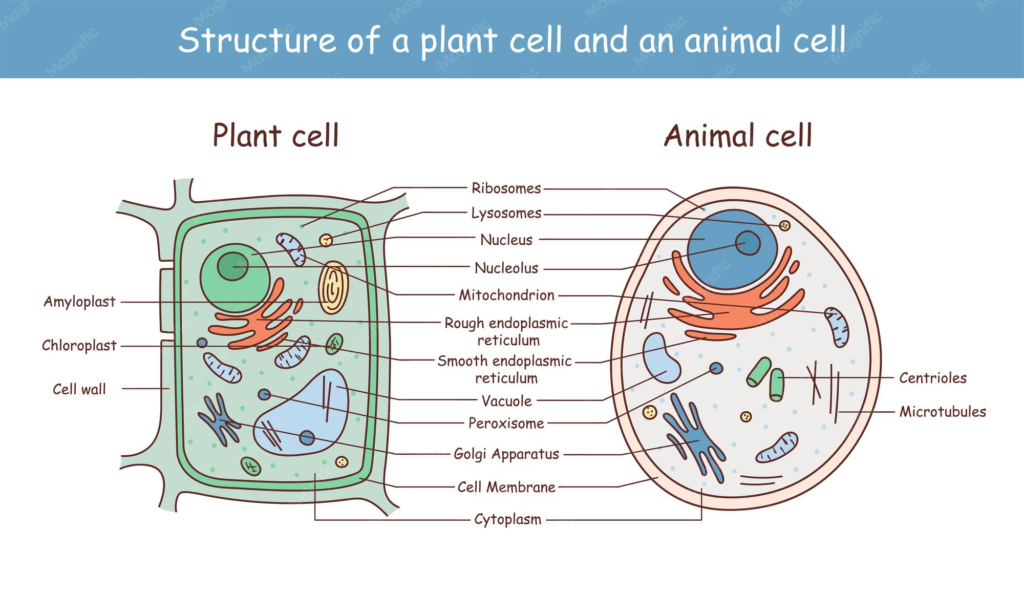
3. With the help of well labelled diagrams, highlight three differences between a plant cell and an animal cell.
Differences between Plant Cell and Animal Cell
| Plant Cell | Animal Cell |
|---|---|
| A plant cell has a cell wall. | An animal cell does not have a cell wall. |
| Plastids are present in plant cells. | Plastids are absent in animal cells. |
| Vacuoles are usually large and prominent. | Vacuoles are small or temporary. |
| Plant cells generally have a fixed shape. | Animal cells usually have irregular shapes. |
| Centrosomes are absent in most plant cells. | Centrosomes are present in animal cells. |
Plant cells are generally rigid because of the cell wall, while animal cells are flexible in nature.
4. Write the functions performed by the following cell organelles.
(a) Endoplasmic Reticulum
- It forms a network for transportation of materials within the cell.
- It helps in the synthesis of proteins and fats.
(b) Golgi Complex
- It stores, modifies and packages substances produced in the cell.
- It helps in secretion and transport of materials.
(c) Nucleus
- It controls all activities of the cell.
- It contains chromosomes and hereditary material.
(d) Chromoplasts
- They provide different colours to fruits and flowers.
- They help attract insects and animals for pollination and seed dispersal.
(e) Vacuoles
- They store food, water and waste materials.
- In plant cells, they help maintain turgidity and rigidity.
(f) Mitochondria
- They produce energy through cellular respiration.
- They are called the powerhouse of the cell.
5. The cell membrane is a very important component of a cell. How is damage to the cell membrane likely to impact the functions of the cell?
The cell membrane forms the outer boundary of the cell and controls the movement of substances into and out of the cell. It protects the internal contents of the cell and maintains balance within it.
If the cell membrane gets damaged:
- harmful substances may enter the cell,
- useful materials may leak out,
- the exchange of nutrients and wastes may get disturbed,
- the cell may lose its shape and protection.
As a result, normal functioning of the cell gets affected and the cell may eventually die.
6. Define the term ‘cell’, for plants/animals. Name the different organelles that make a cell. Explain why none of these is called the structural and functional unit of life.
A cell is the basic structural and functional unit of life. It is the smallest living unit that can perform all life activities.
Both plant and animal cells contain different organelles, such as:
- Cell membrane
- Cytoplasm
- Nucleus
- Mitochondria
- Endoplasmic Reticulum
- Golgi Complex
- Ribosomes
- Vacuoles
Plant cells also contain:
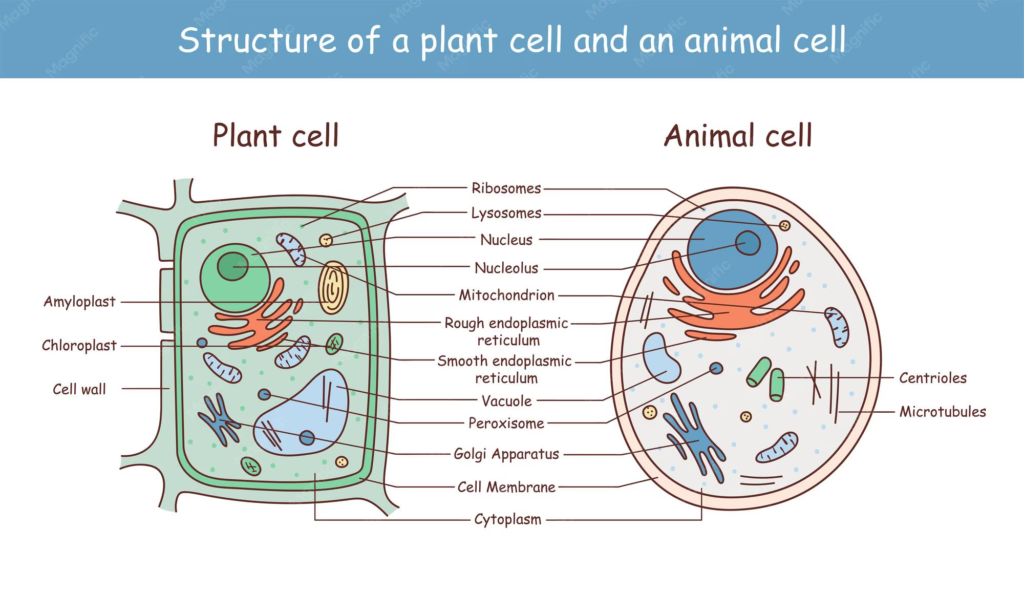
- Cell wall
- Plastids
Each organelle performs a specific function, but none of them can function independently as a complete living unit. Only the entire cell can perform all essential life processes like respiration, nutrition, growth and reproduction.
Therefore, the cell as a whole is called the structural and functional unit of life, and not any individual organelle.
Also Read Class 8 S.St Solution: Home: Tata Dav S.St solutions