Introduction
Welcome to our comprehensive solutions for Tata DAV Class 7 Social Science Chapter 2 – The Earth and Changes on It. This chapter introduces students to the dynamic nature of the Earth and explains how various internal and external forces continuously shape and modify its surface.
In this chapter, students learn about important geographical concepts such as the structure of the Earth, rocks and minerals, weathering, erosion, deposition, and the different agents responsible for bringing changes on the Earth’s surface. Understanding these concepts helps students appreciate how mountains, valleys, rivers, and other landforms are formed and transformed over time.
This article provides complete book exercise solutions, detailed explanations, and easy-to-understand answers prepared according to the latest Tata DAV Class 7 curriculum. The solutions are written in simple language to help students strengthen their conceptual understanding, complete their homework effectively, and prepare confidently for school examinations.
Let’s explore the fascinating processes that continuously reshape our planet through the detailed exercise solutions of Chapter 2: The Earth and Changes on It.
A. Tick (✓) the Correct Option
- Which one of the following is not a human activity?
Answer: (d) formation of mountains - Which one is a Continental glacier?
Answer: (b) Antarctica - Which of the following features are formed by a river?
Answer: (a) ‘V’-shaped valley, meander and delta - Which layer of the soil contains humus?
Answer: (d) top soil - Which soil type is capable of retaining moisture and becomes sticky when wet?
Answer: (b) black soil
B. Fill in the Blanks
- Organic matter when gets decomposed in the soil and converts it into dark coloured material is called humus.
- Alluvial soil is found in a large part of our country.
- ‘V’-shaped and gorge valleys are formed at the youthful stage of a river.
- A cliff is a steep-sided rock facing the sea.
- Ganga river and Brahmaputra river form the largest delta of the world.
C. Give a Single Term for Each of the Following Statements
- Mounds of sand deposited by wind action in deserts.
Answer: Sand dunes - The process in which a gradual wearing and carrying away of soil particles takes place on the earth’s surface.
Answer: Erosion - The process of laying down of sediments carried by various agents of gradation.
Answer: Deposition - A mass of moving ice down the slope.
Answer: Glacier - Removal of the top layer of soil.
Answer: Soil erosion
Keywords for Quick Revision
- Humus → Decayed organic matter in topsoil
- Alluvial Soil → Most widespread soil in India
- Cliff → Steep rock facing the sea
- Sand Dunes → Deposits made by wind
- Erosion → Wearing away of land
- Deposition → Laying down of sediments
- Glacier → Moving mass of ice
- Soil Erosion → Removal of fertile topsoil
Tata DAV Class 7 SST Chapter 2: The Earth and Changes on It
D. Answer the Following Questions in Brief
1. Specify two differences between internal and external forces.
| Internal Forces | External Forces |
|---|---|
| They originate from within the Earth. | They operate on the Earth’s surface. |
| They cause the formation of landforms such as mountains, earthquakes, and volcanoes. | They wear away and reshape landforms through weathering, erosion, and deposition. |
2. Name the various agents of gradation.
The various agents of gradation are:
- Running water (rivers)
- Wind
- Glaciers
- Sea waves
These agents continuously wear away rocks and deposit sediments, thereby changing the Earth’s surface.
3. Distinguish between transported and residual soil.
| Transported Soil | Residual Soil |
|---|---|
| It is carried from one place to another by agents such as rivers, wind, or glaciers. | It remains at the place where it is formed by the weathering of rocks. |
| Example: Alluvial soil. | Example: Black soil and Red soil. |
4. How is a delta formed?
A delta is formed when a river reaches its mouth and enters a sea or an ocean. At this stage, the river slows down and loses its carrying capacity. As a result, it deposits the sediments carried by it over a long period. These deposits accumulate and form a triangular or fan-shaped landform called a delta.
Example: The Ganga-Brahmaputra Delta is the largest delta in the world.
5. Why is humus formed more rapidly in humid areas?
Humus is formed more rapidly in humid areas because these regions receive plenty of rainfall and have warm temperatures. The moisture and heat help microorganisms decompose dead plants and animals quickly. This decomposition produces a dark, fertile organic matter called humus, which enriches the soil and improves its fertility.
E. Answer the Following Questions
1. Explain weathering. Mention the factors that affect the rate of weathering.
Answer:
Weathering is the process by which rocks are broken down into smaller pieces on or near the Earth’s surface. It takes place due to the action of natural agents such as changes in temperature, water, wind, plants, and living organisms. Unlike erosion, weathering does not involve the movement of rock particles from one place to another.
Factors Affecting the Rate of Weathering:
- Climate: Hot and humid climates speed up weathering, whereas cold and dry climates slow it down.
- Nature of Rocks: Soft rocks weather faster than hard rocks.
- Temperature Changes: Continuous heating and cooling cause rocks to expand and contract, leading to cracks.
- Water: Water enters rock cracks and gradually breaks them apart.
- Vegetation: Roots of plants grow into rock crevices and help break rocks into smaller fragments.
Thus, weathering is a continuous natural process that plays an important role in soil formation and in changing the Earth’s surface.
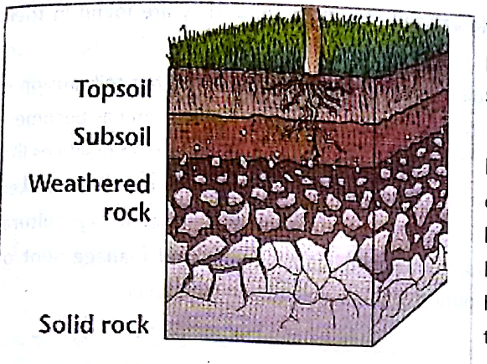
2. Explain the formation of soil with the help of a labelled diagram.
Answer:
Soil is formed from rocks through the process of weathering. Over a long period, rocks break down into smaller particles due to heat, water, wind, and biological activities. Dead plants and animals decompose and mix with these rock particles to form humus, making the soil fertile.
The process of soil formation takes thousands of years. Soil is arranged in different layers called the soil profile.
3. What are the major soil types found in India? Give one important characteristic of each.
Answer:
India has six major types of soil.
| Soil Type | Important Characteristic |
|---|---|
| Alluvial Soil | Very fertile and ideal for agriculture. |
| Black Soil | Retains moisture and becomes sticky when wet. |
| Red Soil | Rich in iron and has a reddish colour. |
| Laterite Soil | Rich in iron and aluminium but less fertile. |
| Desert Soil | Sandy and contains very little moisture. |
| Mountain Soil | Rich in humus and suitable for tea and fruit cultivation. |
Different soil types support different kinds of crops and vegetation and are essential for agriculture and human life.
4. Describe the journey of a river from its source to its mouth.
Answer:
A river begins its journey from its source, usually in mountains or hills where glaciers melt or springs emerge. In its youthful stage, the river flows rapidly down steep slopes and erodes the land, forming V-shaped valleys, gorges, and waterfalls.
As the river reaches the mature stage, the slope becomes gentler. The river slows down and begins to widen its valley. It forms meanders or bends and deposits some of the sediments it carries.
In its old stage, the river flows very slowly over flat plains. Near its mouth, where it enters a sea or ocean, it loses much of its carrying capacity and deposits large amounts of sediments. These deposits often form a delta.
Thus, throughout its journey, a river continuously erodes, transports, and deposits materials, bringing significant changes to the Earth’s surface.
5. Why is conservation of soil important? Suggest three different ways of soil conservation.
Answer:
Soil conservation means protecting soil from erosion and maintaining its fertility. Soil is one of our most precious natural resources because it supports agriculture, provides nutrients to plants, and sustains life on Earth. Since fertile topsoil takes thousands of years to form, its loss can seriously affect food production and the environment.
Three Methods of Soil Conservation:
- Afforestation: Planting more trees helps bind the soil with their roots and prevents erosion.
- Terrace Farming: Steps are made on hill slopes to reduce the speed of flowing water and prevent soil from being washed away.
- Contour Ploughing: Ploughing along the natural contours of the land slows down water flow and reduces soil erosion.
Therefore, conserving soil is essential for protecting agricultural productivity, maintaining ecological balance, and ensuring food security for future generations.
Also Read Chapter 1 CLASS 7
Class 7th ScienceCLASS 7
Class 8th S.St solutionHome: Tata Dav S.St solutions