Introduction to Chapter 8: Transport and Excretion in Plants and Animals (DAV Class 7 Science)
Living organisms need a continuous supply of food, water, oxygen, and nutrients to survive and grow. They also produce waste materials that must be removed from the body. This chapter, “Transportation and Excretion in Plants and Animals,” explains how plants and animals transport essential substances and get rid of wastes.
In plants, water and minerals absorbed by the roots are carried to different parts through the xylem, while the prepared food is transported by the phloem. The chapter also introduces the process of transpiration, through which plants lose excess water in the form of water vapour.
In animals and human beings, the chapter discusses the circulatory system, including the heart, blood, and blood vessels. Students learn about the functions of red blood cells (RBCs), white blood cells (WBCs), and platelets, and understand how the heart pumps blood throughout the body. The chapter also explains the different types of blood vessels—arteries, veins, and capillaries—and their roles in transportation.
The second part of the chapter focuses on excretion, the process of removing waste products from the body. It describes the structure and functions of the human excretory system, including the kidneys, ureters, urinary bladder, and urethra.
This chapter helps students understand that transport and excretion are essential life processes that keep plants and animals healthy and enable them to perform their daily activities efficiently.
.
A. Fill in the blanks
- Water and minerals are transported to various parts of a plant by a network of tubes called the xylem.
- Haemoglobin is the respiratory carrier in blood.
- The upper chambers of the heart are known as atria, while the lower chambers are known as ventricles.
- Septum is the muscular wall that divides the heart lengthwise.
- Excretion in unicellular plants and animals takes place through diffusion.
B. Write True or False
- Phloem transports food from the leaves to the other parts of the plant. – True ✅
- Transpiration is harmful for the plants. – False ❌
- Oxygenated blood from the lungs flows into the left atrium and then to all other parts of the body. – True ✅
- Arteries carry the oxygen-deficient blood back to the heart. – False ❌
- Platelets help in the clotting of blood. – True ✅
- The red colour of the blood is due to the presence of plasma. – False ❌
- Urine is passed out of the body through the urethra. – True ✅
C. Tick (✓) the correct option
- A process that helps in transportation in unicellular organisms is:
✅ Diffusion - In plants, water is transported by the:
✅ Xylem - The blood vessels having thick, elastic walls are called:
✅ Arteries - Which part of the blood has haemoglobin?
✅ RBCs (Red Blood Cells) - Urine gets collected in the:
✅ Urinary bladder
D. Answer the following questions in brief.
1. What will happen if the xylem tissue gets damaged in a branch of a tree?
If the xylem tissue of a branch gets damaged, the transport of water and minerals from the roots to that branch will be affected. As a result, the leaves and other parts of that branch may not receive enough water and nutrients. They may gradually wilt, dry up, and eventually die.
2. Define transpiration.
Transpiration is the process by which plants lose excess water in the form of water vapour through tiny pores called stomata present mainly on the leaves.
3. Name the three types of blood vessels.
The three types of blood vessels are:
- Arteries
- Veins
- Capillaries
4. State any two functions of the blood.
Two important functions of blood are:
- It transports oxygen and digested food to all parts of the body.
- It carries carbon dioxide and other waste products to the excretory organs for removal from the body.
5. Define the term ‘pulse rate’.
Pulse rate is the number of times the arteries expand and contract due to the pumping of blood by the heart in one minute. In a healthy adult, the normal pulse rate is about 72 beats per minute
E. Answer the following questions.
1. Briefly explain the transport of water and minerals in plants.
Plants absorb water and minerals from the soil through their root hairs. These substances then enter the xylem, a tissue made up of tube-like structures. The xylem carries water and dissolved minerals upward from the roots to the stem, branches, and leaves. This continuous movement ensures that every part of the plant receives the water and minerals needed for making food, growth, and other life processes.
2. Describe, in brief, the function of the heart.
The heart is a muscular organ that acts as a pump and continuously circulates blood throughout the body. It has four chambers—two upper chambers called atria and two lower chambers called ventricles.
The right side of the heart receives oxygen-deficient blood from the body and pumps it to the lungs for purification. The left side receives oxygen-rich blood from the lungs and pumps it to all parts of the body. Thus, the heart ensures a constant supply of oxygen and nutrients and helps remove wastes from the body.
3. State the functions of the three types of blood vessels.
The three types of blood vessels and their functions are:
(a) Arteries
Arteries carry oxygen-rich blood away from the heart to different parts of the body. They have thick and elastic walls to withstand the high pressure of blood.
(b) Veins
Veins carry oxygen-deficient blood from different body parts back to the heart. They contain valves that prevent the backward flow of blood.
(c) Capillaries
Capillaries are very thin blood vessels that connect arteries and veins. They allow the exchange of oxygen, nutrients, carbon dioxide, and waste materials between the blood and body cells.
4. Give one function each of RBC, WBC and platelets.
Red Blood Cells (RBCs)
RBCs contain haemoglobin and transport oxygen from the lungs to all parts of the body.
White Blood Cells (WBCs)
WBCs protect the body by fighting disease-causing germs and help in defending the body against infections.
Platelets
Platelets help in the clotting of blood, thereby preventing excessive bleeding when an injury occurs.
5. Draw a neat and well-labelled diagram of the human excretory system.
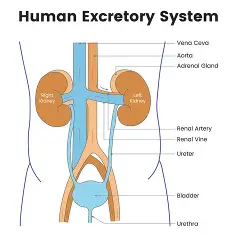
Labels: Left Kidney, Right Kidney, Ureters, Urinary Bladder, and Urethra.
Also Read: Respiration in Living Organisms Class 7 DAV Science Chapter 7 Solutions, Notes, Questions & Answers
aClass 7 Science Chapter 6 Time and Motion DAV Book Solutions | Complete Questions & Answers
aHeat Class 7 DAV Science Chapter 5 Solutions, Notes, Questions & Answers
Class 8 Complete SSTHome: Tata Dav S.St solutions