A. Fill in the blanks
- Yeast and Hydra reproduce through the process of budding.
- Pollen grains are produced by anthers.
- The agents that carry the pollen grains from anther to a stigma are called agents of pollination.
- The fusion of a male gamete with a female gamete is called fertilisation.
- Seeds of orchids get dispersed by wind.
B. Write True or False
- Yeast reproduces asexually through fragmentation. – False
- Sweet potato and dahlia use their roots for asexual reproduction. – True
- A unisexual flower has both stamen and pistil in it. – False
- Water can be an agent of pollination. – True
- Male and female gametes fuse to form the zygote. – True
- Seeds of pea and bean plant are formed in pods. – True
C. Tick (✓) the correct option
- Spirogyra reproduces asexually by: ✓ Fragmentation
- Bryophyllum reproduces through its: ✓ Leaves
- The reproductive part of the plant for sexual reproduction is its: ✓ Flower
- Pollen grains contain the: ✓ Male reproductive cell
- Fruit develops from the: ✓ Ovary
D. Answer the Following Questions in Brief
1. Name the two types of reproduction in plants.
Plants reproduce in two ways—asexual reproduction and sexual reproduction.
2. Define vegetative reproduction.
Vegetative reproduction is a method of asexual reproduction in which new plants arise from the roots, stems, or leaves of the parent plant instead of from seeds.
3. Give two examples of plants which reproduce through spore formation.
Fern and moss are two plants that reproduce by forming spores.
4. Name two artificial methods of vegetative propagation from stem.
Two commonly used artificial methods of vegetative propagation through stems are grafting and layering.
5. When is a flower said to be a bisexual flower?
A flower is called bisexual when it possesses both stamens (male parts) and pistil (female part) in the same flower.
6. Name any three ways by which seeds are dispersed.
Seeds can be dispersed by wind, water, and animals
E. Answer the Following Questions
(DAV Class 7 Science Chapter 9 – Reproduction in Plants)
1. In what ways is vegetative propagation better than sexual reproduction?
Vegetative propagation has several advantages over sexual reproduction. It is a faster and easier method of producing new plants. The new plants are identical to the parent plant, so they retain all the desirable qualities, such as good taste, better yield, and disease resistance. It also helps in growing plants that do not produce seeds or have seeds that do not germinate easily, such as banana, rose, and sugarcane. Thus, vegetative propagation is widely used by gardeners and farmers to obtain healthy and uniform plants in a short time.
2. Draw a well-labelled diagram to describe the parts of a flower.
Well-labelled parts of a flower:
- Sepals
- Petals
- Stamen (Anther and Filament)
- Pistil (Stigma, Style and Ovary)
- Ovules
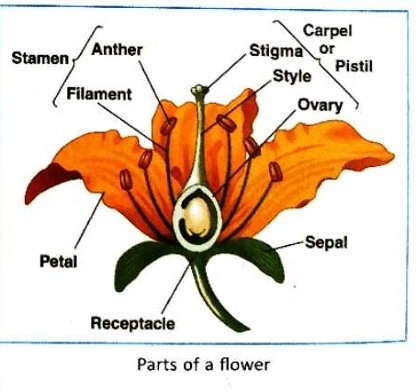
The stamen is the male reproductive part of the flower, while the pistil is the female reproductive part. Together, these parts help in the process of reproduction and seed formation.
3. How is self-pollination different from cross-pollination?
| Self-pollination | Cross-pollination |
|---|---|
| Pollen grains are transferred to the stigma of the same flower or another flower on the same plant. | Pollen grains are transferred to the stigma of a flower on a different plant of the same kind. |
| Usually does not require external agents. | Generally requires agents such as wind, water, insects, birds, or animals. |
| Produces less variation among offspring. | Produces greater variation and often leads to stronger plants. |
Both types of pollination help plants reproduce, but cross-pollination increases diversity and enables plants to adapt better to changing environments.
4. How are fruits formed?
After pollination and fertilisation, the ovary of the flower begins to develop into a fruit. The ovules inside the ovary change into seeds, while the ovary wall forms the fruit covering. The fruit protects the developing seeds and often helps in their dispersal. Thus, fruits are formed as a result of successful fertilisation and play an important role in the continuation of plant life.
5. Why is dispersal of seeds necessary for growth of plants?
Seed dispersal is necessary because it prevents overcrowding of plants in one place. If all seeds fell near the parent plant, the young plants would compete for sunlight, water, nutrients, and space. By spreading to different places, seeds get better opportunities to germinate and grow into healthy plants. Seed dispersal also helps plants colonise new areas, ensuring their survival and maintaining the balance of nature. Thus, dispersal is an important process that supports the growth and continuity of plant life.
Also read: DAV Class 7 SCIENCE Ch 8 Question Answer – TRASPORTAION IN ANIMALS AND PLANTS
Respiration in Living Organisms Class 7 DAV Science Chapter 7 Solutions, Notes, Questions & Answers
Class 7 Science Chapter 6 Time and Motion DAV Book Solutions | Complete Questions & Answers
Calss 8th Complete SST solutionHome: Tata Dav S.St solutions