- DAV Class 7 SST Chapter 4 The Atmosphere Notes and Question Answers | Full Exercise Solutions
DAV Class 7 SST Chapter 4 Air Around Us Notes and Question Answers | Full Exercise Solutions
DAV Class 7 SST Chapter 4 The Atmosphere Question Answers | MCQs, Fill in the Blanks, Match the Following, Short & Long Answer Solution
AV Class 7 SST Chapter 4 The Atmosphere Question Answers | MCQs, Fill in the Blanks, Match the Following, Short & Long Answer Solut
A. Tick (✔) the correct option.
- In normal lapse rate, temperature decreases at the rate of 1°C with every—
✔ (a) 165 m ascend - Which layer is safe for flying aircrafts?
✔ (b) Stratosphere - The role of ion-particles in the ionosphere is to—
✔ (b) Enable wireless communication - Which one of the following is the main cause of global warming?
✔ (a) Air pollution - Smog causes—
✔ (a) Breathing problems
B. Fill in the blanks.
- Atmosphere is mainly composed of three major gases—nitrogen, oxygen, and carbon dioxide.
- Gases like argon, helium, methane, etc., are present in small amounts in the air.
- All weather phenomena occur in the troposphere.
- Atmospheric conditions over a long period of time and on a larger area is called climate.
- The normal air pressure at sea level is 1013.25 millibars.
C. Match the following.
| Column A | Column B |
|---|---|
| 1. Mono-oxide gas | b. Most harmful gas present in the atmosphere |
| 2. Weather | e. Atmospheric conditions for a specific place covering a short period of time |
| 3. Barometer | d. An instrument to measure atmospheric pressure |
| 4. Atmospheric Pressure | a. Weight or pressure exerted by the air |
| 5. Rainfall | c. The falling of water drops on the earth’s surface |
Final Answers:
1 → b
2 → e
3 → d
4 → a
5 → c
DAV Class 7 SST Chapter 4– Air Around Us: Short Answer Questions (D)
DAV Class 7 SST Chapter-4 Air around Us Questions Answers, DAV Class 7 Social Science Solutions, Class 7 SST The Atmosphere Answers, DAV Solutions Class 7 SST
1. Name the layers of the atmosphere.
Answer:The atmosphere is divided into five layers:
- Troposphere
- Stratosphere
- Mesosphere
- Thermosphere (Ionosphere)
- Exosphere
These layers protect life on Earth and perform different functions, such as regulating weather and blocking harmful radiations.
2. How do plants absorb nitrogen?
Although nitrogen is abundant in the atmosphere, plants cannot use it directly. They absorb nitrogen from the soil in the form of nitrates and nitrites. Certain bacteria present in the soil and the roots of leguminous plants convert atmospheric nitrogen into usable compounds. This natural process helps plants grow and maintain the balance of life on Earth.
3. What is the importance of water vapours in the atmosphere?
Water vapour is essential for life because it:
- Forms clouds, rain, and other forms of precipitation.
- Helps in regulating the Earth’s temperature by absorbing and releasing heat.
- Maintains the water cycle, ensuring a continuous supply of fresh water.
From a humanistic perspective, water vapour supports agriculture, provides drinking water, and sustains all living beings. Without it, life on Earth would become extremely difficult.
4. Name the different variables of atmosphere.
The main variables or elements of the atmosphere are:
- Temperature
- Air Pressure
- Humidity
- Winds
- Rainfall (Precipitation)
These atmospheric variables together determine the weather conditions of a place and influence human activities, farming, transportation, and daily life.
5. What type of climate does India have?
India has a Tropical Monsoon Climate. It is characterised by:
- Distinct seasons of summer, rainy season, autumn, winter, and spring.
- Seasonal winds called monsoons, which bring most of the country’s rainfall.
The monsoon climate is vital for India’s agriculture and economy because millions of people depend on rainfall for farming and water resources. Thus, the climate of India not only shapes the natural environment but also deeply influences the lives and livelihoods of its people.
DAV Class 7 SST Chapter The Atmosphere Question Answer | Short Answer Questions (D) Solutions
DAV Class 7 SST Chapter – The Atmosphere: Long Answer Questions (E)
DAV Class 7 SST Chapter_4 Air Around Us Question Answers, Class 7 SST The Atmosphere Solutions,
1. What is the importance of carbon dioxide and oxygen for living beings?
Answer:
Carbon dioxide and oxygen are two essential gases that make life possible on Earth.
Oxygen is necessary for the process of respiration. Human beings and animals breathe in oxygen to release energy from food, which helps them perform all life activities. Without oxygen, the survival of most living organisms would be impossible.
Carbon dioxide is equally important because green plants use it during photosynthesis to prepare their food. In this process, plants also release oxygen into the atmosphere, which is then used by humans and animals.
From a humanistic perspective, these gases teach us the importance of interdependence in nature. Plants, animals, and human beings are connected through a natural cycle where each supports the other’s existence. Therefore, protecting forests and reducing air pollution are essential responsibilities for preserving this balance and ensuring a healthy future for all living beings.
2. Name three major sources of pollutants in the air. Also state the ill-effects of these air pollutants.
Answer:
Major sources of air pollutants:
- Smoke released from factories and industries.
- Exhaust fumes from motor vehicles.
- Burning of fuels, garbage, and firecrackers.
Ill-effects of air pollutants:
- Cause respiratory diseases such as asthma and bronchitis.
- Lead to eye irritation and breathing problems.
- Increase global warming and climate change.
- Damage plants, animals, and ecosystems.
- Result in smog and acid rain.
From a humanistic viewpoint, air pollution affects everyone, but children, the elderly, and economically weaker communities suffer the most. Therefore, every citizen should adopt eco-friendly practices, use public transport, plant more trees, and conserve the environment for the well-being of present and future generations.
3. What is the importance of ozone gas? Why is global warming a threat to life on the Earth?
Answer:
The ozone layer, present in the stratosphere, acts as a protective shield around the Earth. It absorbs most of the Sun’s harmful ultraviolet (UV) rays and prevents them from reaching the Earth’s surface. Without this protective layer, living organisms would face serious health problems such as skin diseases, eye disorders, and damage to crops and marine life.
Global warming refers to the gradual increase in the Earth’s average temperature due to the excessive accumulation of greenhouse gases like carbon dioxide.
Global warming is a threat because it:
- Causes melting of glaciers and polar ice caps.
- Raises sea levels and increases the risk of flooding.
- Disturbs weather patterns and rainfall.
- Leads to droughts, heat waves, and loss of biodiversity.
- Affects agriculture, water resources, and human health.
From a humanistic perspective, global warming is not merely an environmental issue but a challenge to humanity itself. Protecting the atmosphere through afforestation, energy conservation, and reducing pollution is our collective responsibility towards both present and future generations.
4. How is rainfall caused? Explain it with the help of a diagram.
Answer:
Rainfall is caused through the water cycle. The heat of the Sun causes water from oceans, rivers, lakes, and plants to evaporate and rise into the atmosphere as water vapour. As the vapour rises, it cools and condenses into tiny water droplets, forming clouds. When these droplets become heavy, they fall back to the Earth in the form of rain.
Diagram:
Sun’s Heat → Evaporation → Condensation → Clouds → Rainfall
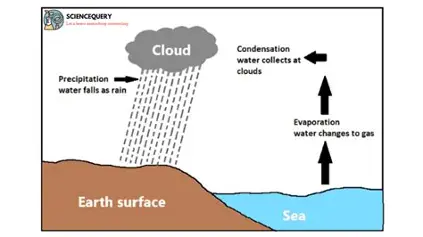
Rainfall is a precious natural resource because it provides water for drinking, agriculture, industries, and ecosystems. It reminds us that all forms of life depend on the continuous movement and conservation of water.
5. Write the difference between weather and climate.
| Weather | Climate |
|---|---|
| It refers to the atmospheric conditions of a place for a short period of time. | It refers to the average atmospheric conditions of a place over a long period. |
| Changes frequently from hour to hour or day to day. | Remains relatively stable over many years. |
| It includes daily changes in temperature, rainfall, humidity, and wind. | It represents the general pattern of temperature and rainfall of a region. |
| Example: A rainy day in Delhi. | Example: India’s Tropical Monsoon Climate. |
From a humanistic perspective, understanding weather helps people plan their daily activities and remain safe during extreme conditions, while understanding climate helps societies prepare for agriculture, water management, and sustainable development. Both are essential for improving human life and maintaining harmony with nature.
Components of Environment Class 7 SST Chapter 1 DAV Solutions, Notes, Question Answers & MCQsAls read: CLASS 7
aDAV Class 7 SCIENCE Ch 8 Question Answer – TRASPORTAION IN ANIMALS AND PLANTS