A. Fill in the blanks.
1. ________ and ________ are non-renewable sources of energy.
Answer: Coal and petroleum are non-renewable sources of energy.
2. ________ is a major renewable, natural resource.
Answer: Sunlight is a major renewable, natural resource.
3. The process, in which coal is strongly heated in the absence of air, is known as ________.
Answer: The process, in which coal is strongly heated in the absence of air, is known as destructive distillation.
4. In oil wells, ________ is always found above the layer of petroleum.
Answer: In oil wells, natural gas is always found above the layer of petroleum.
5. ________ is a black viscous liquid, obtained by destructive distillation of coal.
Answer: Coal tar is a black viscous liquid, obtained by destructive distillation of coal.
B. State True or False for the following statements.
1. Fossil fuels are renewable natural resources.
Answer: False
2. Anthracite has higher carbon content than lignite.
Answer: True
3. Coke can be used to make fuel gases.
Answer: True
4. Natural gas is found below the petroleum layers.
Answer: False
5. Burning of fossil fuels is a major source of pollution.
Answer: True
C. Tick (✓) the correct option.
1. The highest grade of coal is known as—
- ☐ lignite
- ☐ bituminous
- ☑ anthracite
- ☐ peat
Answer: Anthracite
2. Coke and coal tar are obtained from—
- ☐ petroleum
- ☑ coal
- ☐ natural gas
- ☐ diesel
Answer: Coal
3. Different types of coal generally have the—
- ☐ same content of volatile material and same percentage of carbon.
- ☐ same content of volatile material but different percentage of carbon.
- ☐ different content of volatile material but same percentage of carbon.
- ☑ different content of volatile material as well as different percentage of carbon.
Answer: Different content of volatile material as well as different percentage of carbon.
4. A product, that is not obtained through the refining of petroleum, is—
- ☐ diesel
- ☑ coal gas
- ☐ kerosene
- ☐ petrol
Answer: Coal gas
5. Which of the following is a renewable source of energy?
- ☑ tidal energy
- ☐ coal
- ☐ diesel
- ☐ petrol
Answer: Tidal energy
D. Answer the following questions in brief.
(DAV Living Science Class 8 – Chapter: Coal and Petroleum)
1. Define the term ‘fuel’.
Answer:
A fuel is a substance that burns in the presence of oxygen to produce heat energy, which can be used for cooking, heating, transportation, and generating electricity.
2. Name any two renewable natural sources of energy.
Answer:
Two renewable natural sources of energy are:
- Solar energy
- Wind energy
3. Define the term ‘carbonisation’.
Answer:
Carbonisation is the slow process by which the remains of dead plants buried deep inside the Earth are converted into coal under high temperature and pressure over millions of years.
4. Name the three main products obtained from destructive distillation of coal.
Answer:
The three main products obtained from the destructive distillation of coal are:
- Coke
- Coal tar
- Coal gas
5. State two uses each of the following:
(a) Asphalt
Answer:
- It is used for surfacing roads and highways.
- It is used for waterproofing roofs and buildings.
(b) Paraffin wax
Answer:
- It is used for making candles.
- It is used in the manufacture of ointments, cosmetics, and polishes.
6. Write the full forms of CNG, LPG and PNG.
Answer:
- CNG – Compressed Natural Gas
- LPG – Liquefied Petroleum Gas
- PNG – Piped Natural Gas
- E. Answer the following questions.
(DAV Living Science Class 8 – Chapter: Coal and Petroleum)
1. Describe, in brief, the process of ‘coal formation’.
Answer:
Coal was formed millions of years ago from the remains of dead plants that grew in swampy forests. When these plants died, they got buried under layers of soil and rocks. Over a long period of time, the buried plant material was subjected to high temperature and pressure in the absence of air. Gradually, the moisture and volatile substances were removed, increasing the carbon content. This slow process of converting dead vegetation into coal is called carbonisation.
Depending on the carbon content and the amount of volatile matter present, different types of coal such as peat, lignite, bituminous coal, and anthracite are formed.
2. Differentiate between lignite and bituminous coal.
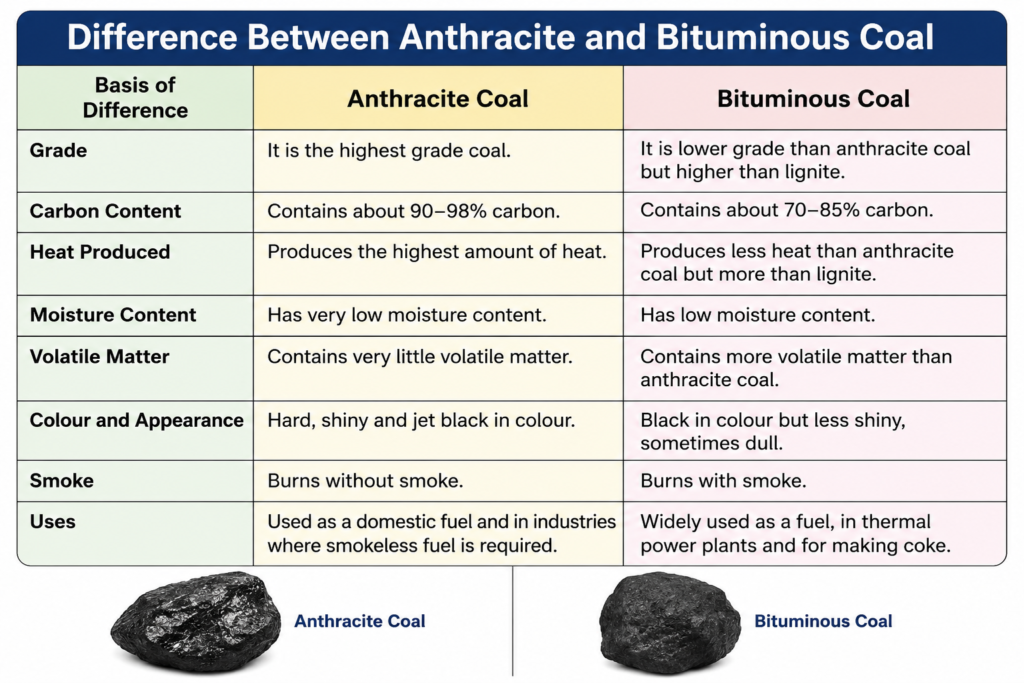
Answer: For answer check end of the exercise.
3. How do petroleum and natural gas occur in nature?
Answer:
Petroleum and natural gas are fossil fuels formed from the remains of tiny marine plants and animals that lived millions of years ago. After these organisms died, they settled at the bottom of seas and oceans and were buried under layers of sand and clay. Due to high pressure and temperature over millions of years, they were converted into petroleum and natural gas.
These fuels are found trapped between layers of impermeable rocks. In an oil well, natural gas is present at the top because it is lighter, petroleum lies below it, and water is found at the bottom.
4. State the main advantages of using natural gas.
Answer:
Natural gas has several advantages over other fossil fuels:
It is a clean fuel and burns without producing smoke or ash.
It has a high calorific value, so it produces a large amount of heat.
It causes less air pollution because it emits fewer harmful gases.
It can be easily transported through pipelines (PNG) and stored as CNG.
It is widely used as a domestic fuel, industrial fuel, and automobile fuel.
5. Keeping in mind their availability in nature, explain the need of using coal and petroleum judiciously.
Answer:
Coal and petroleum are non-renewable natural resources. They take millions of years to form, but are being consumed much faster than they are formed. Their reserves are limited and may get exhausted if used carelessly.
The excessive use of coal and petroleum also causes serious environmental problems such as air pollution, global warming, and acid rain due to the release of carbon dioxide and other harmful gases.
Therefore, these fuels should be used judiciously by:
1. - avoiding unnecessary wastage of fuel,
using public transport or carpooling,
switching off vehicles and machines when not in use,
using energy-efficient appliances, and
promoting renewable sources of energy such as solar and wind energy.
Using coal and petroleum wisely helps conserve these valuable resources for future generations and protects the environment.
Frequently Asked Questions (FAQs) – Sources of Energy (DAV Class 8 Chapter 6)
1. What are sources of energy?
Answer:
Sources of energy are substances or natural resources that provide energy to perform various activities such as cooking, transportation, electricity generation, and industrial work. Examples include coal, petroleum, natural gas, solar energy, and wind energy.
2. What is the difference between renewable and non-renewable sources of energy?
Answer:
Renewable sources of energy can be replenished naturally in a short period, such as solar, wind, and tidal energy. Non-renewable sources, such as coal, petroleum, and natural gas, take millions of years to form and cannot be replaced quickly.
3. What is carbonisation?
Answer:
Carbonisation is the slow process by which the remains of dead plants buried deep inside the Earth are converted into coal under high pressure and temperature over millions of years.
4. What are the four main types of coal?
Answer:
The four main types of coal are:
- Peat
- Lignite
- Bituminous Coal
- Anthracite
Anthracite is the highest grade of coal because it contains the maximum amount of carbon.
5. What is destructive distillation of coal?
Answer:
Destructive distillation is the process of heating coal strongly in the absence of air. It produces useful products such as coke, coal tar, and coal gas.
6. What are the main products obtained from petroleum?
Answer:
The main products obtained by refining petroleum are:
- Petrol
- Diesel
- Kerosene
- Liquefied Petroleum Gas (LPG)
- Paraffin Wax
- Lubricating Oil
- Asphalt
7. Why is natural gas considered a clean fuel?
Answer:
Natural gas burns completely without producing smoke or ash. It releases fewer harmful gases than coal and petroleum, making it an environmentally friendly fuel.
8. What is the difference between anthracite and bituminous coal?
Answer:
Anthracite is the highest-grade coal with about 90–98% carbon and produces the maximum heat with very little smoke. Bituminous coal contains about 70–85% carbon, produces less heat than anthracite, and is widely used as a fuel and for manufacturing coke.
9. Why should coal and petroleum be used judiciously?
Answer:
Coal and petroleum are non-renewable resources. They take millions of years to form but are consumed rapidly. Excessive use also causes air pollution and global warming. Therefore, they should be used carefully and conserved for future generations.
10. What are the advantages of using renewable sources of energy?
Answer:
Renewable sources of energy:
- Do not get exhausted.
- Cause very little pollution.
- Help conserve fossil fuels.
- Reduce greenhouse gas emissions.
- Are environmentally friendly.
11. Where are petroleum and natural gas found in an oil well?
Answer:
In an oil well:
- Natural gas is found at the top.
- Petroleum (crude oil) is found below the natural gas.
- Water is found at the bottom.
12. Which is the highest grade of coal and why?
Answer:
Anthracite is the highest grade of coal because it contains the highest percentage of carbon (about 90–98%), produces the maximum heat, and burns with very little smoke.
13. What are the full forms of CNG, LPG, and PNG?
Answer:
- CNG – Compressed Natural Gas
- LPG – Liquefied Petroleum Gas
- PNG – Piped Natural Gas
14. What are the examples of renewable sources of energy?
Answer:
Examples of renewable sources of energy include:
- Solar energy
- Wind energy
- Hydroelectric energy
- Tidal energy
- Biomass energy
- Geothermal energy
15. Why is solar energy considered the best renewable source of energy?
Answer:
Solar energy is considered one of the best renewable sources because it is abundant, non-polluting, freely available, and can be used to generate electricity and heat without harming the environment.
Also Read Class 6th solution
CLASS 7 solutions
DAV Class 8 SST Chapter 14 The Nationalist Movement (1870 to 1947) Solutions