Class 7 Tata DAV Living Science Solutions are specially created to make scientific learning simple, interesting, and easy to understand for students. These solutions include answers to all chapters of the “The Living World” textbook along with clear explanations, well-labeled diagrams, and step-by-step solutions for every exercise. They help students build a strong understanding of concepts, improve analytical skills, and perform better in school examinations as well as other academic assessments.
These Tata DAV Class 7 Science Solutions serve as an excellent resource for revision, self-study, classroom preparation, and exam practice. Every answer follows the DAV syllabus pattern and is explained in a systematic manner to help students score higher marks. In addition to textbook answers, the solutions often provide important notes, key definitions, extra practice questions, and chapter summaries for a deeper understanding of the subject
A. Fill in the blanks
- Animals are heterotrophs as they cannot synthesise their own food.
- The roots of a plant absorb water and minerals from the soil.
- During photosynthesis plants take in carbon dioxide and release oxygen.
- Stomata are the tiny pores through which leaves exchange gases.
- Insect eating plants are called insectivorous plants.
- An essential raw material needed for the process of photosynthesis, and
(a) available in the soil is water.
(b) available in the air is carbon dioxide.
B. Match the following
- Chlorophyll — (d) Leaf
- Lichens — (c) Symbiotic relationship
- Fungi — (b) Saprotrophs
- Amarbel — (e) Parasite
- Plants — (a) Autotrophs
C. Tick (✓) the correct option
- Green plants, that can synthesise their own food, are known as —
✅ autotrophs - The food factory of the plant is its —
✅ leaf - Which of the following is an insectivorous plant?
✅ pitcher plant - Mushroom is an example of a/an —
✅ saprotroph - An organism that fixes nitrogen in the soil is —
✅ rhizobium
D. Answer the following questions in brief.
1. Why is nutrition important for a living organism?
Nutrition is important for every living organism because it provides energy to perform various life activities such as growth, movement, respiration, and reproduction. It also helps in repairing damaged body parts and maintaining good health. Without proper nutrition, living organisms cannot survive, grow, or remain active. Just as machines need fuel to work, living beings need food and nutrients to live a healthy life.
2. How do green plants synthesise their food?
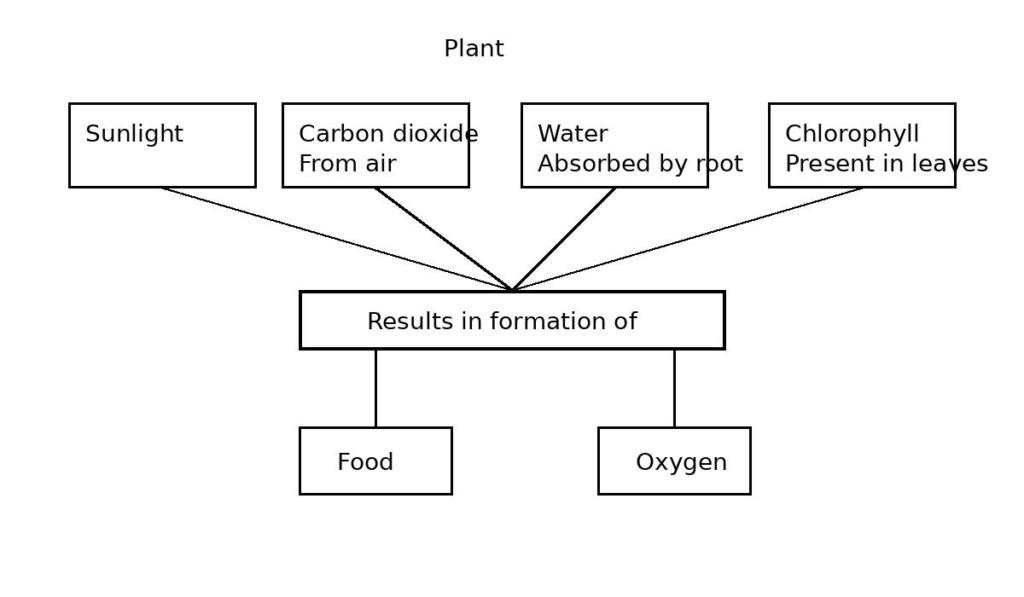
Green plants synthesise their food by the process of photosynthesis. The leaves of plants contain a green pigment called chlorophyll which traps sunlight. Plants take water from the soil through their roots and carbon dioxide from the air through stomata present on the leaves. Using sunlight, chlorophyll helps plants convert water and carbon dioxide into food in the form of glucose. During this process, oxygen is released into the atmosphere, which is essential for all living beings.
3. State the role of ‘vessels’ present in a plant.
Vessels in plants help in the transportation of substances from one part of the plant to another. Xylem vessels carry water and minerals from the roots to the leaves, while phloem vessels transport the prepared food from the leaves to all parts of the plant. These vessels act like pipelines in the plant body and help the plant remain healthy and alive.
4. Define the following terms:
(a) Symbiotic relationship
A symbiotic relationship is a relationship in which two different organisms live together and both are benefited from each other. For example, in lichens, the alga prepares food while the fungus provides shelter and water.
(b) Nutrients
Nutrients are the useful substances present in food that provide energy, help in growth, repair the body, and protect us from diseases. Examples include carbohydrates, proteins, vitamins, minerals, fats, and water.
(c) Saprotrophic mode of nutrition
Saprotrophic mode of nutrition is the method in which organisms obtain food from dead and decaying matter. Organisms like mushrooms and fungi secrete digestive juices on dead matter and absorb the dissolved nutrients.
(d) Photosynthesis
Photosynthesis is the process by which green plants prepare their own food using sunlight, chlorophyll, water, and carbon dioxide. Oxygen is released during this process.
5. When some wheat dough was left in the open for a few days, it started emitting a foul smell. State, why?
When wheat dough is left in the open for a few days, fungi and bacteria start growing on it because of moisture and warmth. These microorganisms decompose the dough and produce harmful substances and gases, which cause a foul smell. This process is a result of the saprotrophic mode of nutrition shown by microorganisms
E. Answer the following questions.
1. Why would life not be possible on the earth in the absence of photosynthesis?
Photosynthesis is one of the most important natural processes on Earth. Through photosynthesis, green plants prepare food using sunlight, water, and carbon dioxide. This food becomes the primary source of energy for almost all living organisms, either directly or indirectly. Animals and human beings depend on plants for food, and even meat-eating animals depend on plant-eating animals for survival. Thus, the entire food chain begins with green plants.
Photosynthesis also releases oxygen into the atmosphere. Oxygen is essential for respiration in most living organisms. Without oxygen, humans, animals, and many other organisms would not be able to survive. In addition, photosynthesis helps maintain the balance between oxygen and carbon dioxide in nature.
Therefore, in the absence of photosynthesis, there would be no food and no oxygen on Earth. Life would gradually come to an end, making photosynthesis essential for the survival of all living beings.
2. Give reasons for the following:
(a) Mushroom is a saprotroph.
Mushroom is called a saprotroph because it obtains its food from dead and decaying organic matter. It cannot prepare its own food as it does not contain chlorophyll. Mushrooms secrete digestive juices on dead matter, convert it into a simple soluble form, and then absorb the nutrients. In this way, mushrooms help in the decomposition of waste materials and keep the environment clean.
(b) Sun is the ultimate source of energy for all living organisms.
The Sun is called the ultimate source of energy because green plants use sunlight to prepare food through photosynthesis. This food stores solar energy in it. Animals get this energy by eating plants or by eating other animals that depend on plants. Thus, all living organisms receive energy directly or indirectly from the Sun. Without sunlight, plants would not be able to make food, and life on Earth would not survive.
(c) The leaf of a plant ‘dies out’ if its stomata are blocked.
Stomata are tiny pores present on the surface of leaves. They help in the exchange of gases and the removal of excess water through transpiration. If the stomata are blocked, the leaf cannot take in carbon dioxide required for photosynthesis and cannot release oxygen and water vapour properly. As a result, important life processes are disturbed, and the leaf gradually dries up and dies.
(d) Leaf is known as the food factory of the plant.
The leaf is called the food factory of the plant because it is the main site where photosynthesis takes place. Leaves contain chlorophyll, a green pigment that absorbs sunlight. Using sunlight, water, and carbon dioxide, leaves prepare food for the entire plant. The prepared food is then transported to different parts of the plant through vessels. Since leaves produce food for the plant, they are known as the food factory.
(e) Lichen is a ‘living partnership’ between a fungus and an alga and this ‘partnership’ is beneficial to both.
Lichen is an example of a symbiotic relationship in which an alga and a fungus live together and help each other. The alga contains chlorophyll and prepares food by photosynthesis. The fungus provides water, minerals, and shelter to the alga. In this partnership, both organisms benefit from each other and survive comfortably. Therefore, lichen is called a “living partnership” that is useful for both the fungus and the alga.
3. Why do some plants feed on insects? How does a pitcher plant catch insects?
Some plants grow in soils that are poor in nitrogen and minerals. To fulfil their nutritional needs, they trap and digest insects. These plants are called insectivorous plants. By feeding on insects, they obtain nitrogen and other nutrients necessary for their growth.
A pitcher plant has a modified leaf shaped like a pitcher with a lid at the top. The plant attracts insects with its bright colour and sweet-smelling nectar. When an insect sits on the slippery edge of the pitcher, it falls inside. The lid closes, and digestive juices present inside the pitcher digest the insect. The plant then absorbs the nutrients from the digested insect.
4. How do rhizobium bacteria and leguminous plants help each other in their survival?
Rhizobium bacteria live in the root nodules of leguminous plants such as pea, gram, and beans. These bacteria convert atmospheric nitrogen into a usable form for the plants. Nitrogen is essential for plant growth and the formation of proteins.
In return, the leguminous plants provide food and shelter to the bacteria. Thus, both the bacteria and the plants benefit from each other. This mutual relationship helps in improving soil fertility and maintaining the balance of nutrients in nature.
Also Read: Class 8 S.st complete solutionHome: Tata Dav S.St solutions
Class Sixth: ScienceClass 6th