A. Fill in the blanks
- The digestion of food in humans starts in the mouth and is completed in the small intestine.
- Hydrochloric acid, present in the stomach, kills bacteria.
- The largest gland in the human body is the liver.
- Partially digested food, that is chewed again by grass-eating animals, is called the cud.
- Amoeba uses pseudopodia for locomotion and for capturing its food.
B. Match the following
- Gall bladder — (a) Bile Juice
- Proteins — (e) Amino acids
- Intestinal wall — (c) Absorption
- Rumen — (b) Cow
- Pseudopodia — (d) False feet
C. Tick (✓) the correct option
- Organisms that can synthesise their own food are called —
✅ autotrophs - Cow is a/an —
✅ heterotroph - Animals that eat both plant materials and animals are called —
✅ omnivores - Which one of these is not a part of the alimentary canal?
✅ liver - Bile juice is released by the —
✅ liver
D. Answer the following questions in brief.
1. Define the following terms:
(a) Holozoic nutrition
Holozoic nutrition is the mode of nutrition in which organisms take in solid food, digest it inside the body, absorb the useful nutrients, and remove the undigested waste. Humans, dogs, cows, and many other animals show holozoic nutrition. This process helps organisms obtain energy and nutrients necessary for growth and survival.
(b) Alimentary canal
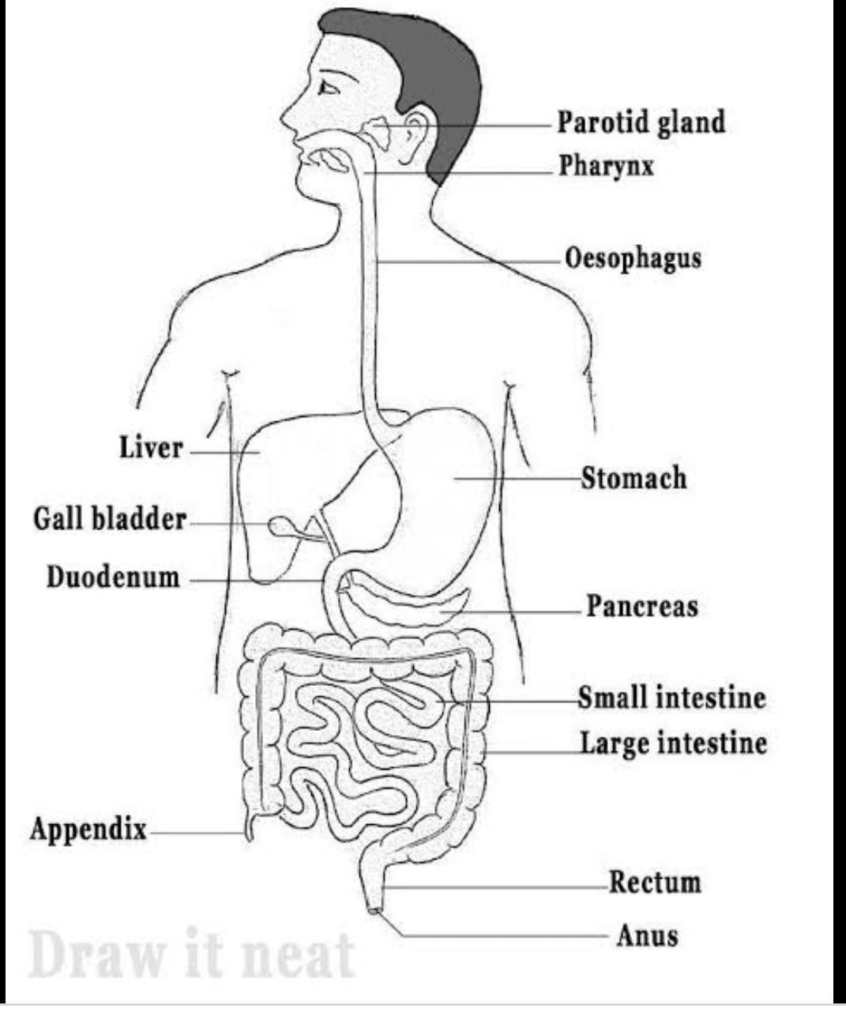
The alimentary canal is a long muscular tube through which food passes in the body during digestion. It begins at the mouth and ends at the anus. It includes organs such as the mouth, oesophagus, stomach, small intestine, large intestine, rectum, and anus. The alimentary canal helps in digestion, absorption of nutrients, and removal of waste materials.
2. Give the meaning of the terms:
(a) Assimilation
Assimilation is the process by which absorbed nutrients are used by the body for growth, repair, and obtaining energy. After digestion and absorption, the useful food materials become a part of body tissues and help the body remain healthy and active.
(b) Rumination
Rumination is the process in which cud-chewing animals like cows and buffaloes bring back partially digested food from the stomach into the mouth and chew it again. This helps in proper digestion of grass and other fibrous food materials.
3. Name the organs that make up the human alimentary canal.
The organs that make up the human alimentary canal are:
- Mouth
- Buccal cavity
- Oesophagus (food pipe)
- Stomach
- Small intestine
- Large intestine
- Rectum
- Anus
These organs work together to digest food, absorb nutrients, and remove waste from the body.
4. State two differences between milk teeth and permanent teeth.
| Milk Teeth | Permanent Teeth |
|---|---|
| Milk teeth are temporary teeth. | Permanent teeth are fixed for lifetime. |
| They are 20 in number. | They are 32 in number in adults. |
Milk teeth help children chew food during early years, while permanent teeth are stronger and designed for long-term use.
5. Name the four types of teeth in the human mouth.
The four types of teeth present in the human mouth are:
- Incisors
- Canines
- Premolars
- Molars
Each type of tooth performs a special function in chewing and digestion.
6. State the function of the following:
(a) Incisor teeth
Incisor teeth are used for cutting and biting food into small pieces. They are the sharp front teeth present in the mouth.
(b) Premolar teeth
Premolar teeth help in crushing and grinding food so that it can be swallowed easily and digested properly.
7. State the role of acid in the human stomach.
Hydrochloric acid present in the stomach helps in killing harmful bacteria that enter the body with food. It also creates an acidic medium which helps digestive enzymes work properly for the digestion of proteins. Thus, the acid plays an important role in healthy digestion and protection from infections.
8. State the function of:
(a) Bile juice
Bile juice is produced by the liver and stored in the gall bladder. It helps in the digestion of fats by breaking large fat droplets into smaller ones. It also neutralises the acidic food coming from the stomach.
(b) Pancreatic juice
Pancreatic juice is secreted by the pancreas. It contains enzymes that help digest carbohydrates, proteins, and fats. This juice plays an important role in completing the digestion process in the small intestine.
E. Answer the following questions.
1. Draw a neat, well-labelled diagram of the human digestive system.
2. Justify the following statements:
(a) Crow is an omnivore.
A crow is called an omnivore because it eats both plant products and animal matter. It feeds on grains, fruits, seeds, insects, meat, and even waste food. Since it consumes both plants and animals for nutrition, it is classified as an omnivorous animal. This habit also helps keep the environment clean by eating leftover and decaying materials.
(b) It is said that the mode of nutrition in human beings and Amoeba is quite similar.
The mode of nutrition in humans and Amoeba is similar because both follow holozoic nutrition. In both organisms, food is ingested, digested, absorbed, assimilated, and the undigested waste is removed from the body.
However, the methods are different. Humans use a well-developed digestive system, while Amoeba captures food using pseudopodia and digests it inside a food vacuole. Even though their body structures differ greatly, the basic steps of nutrition remain almost the same.
3. Give reasons for the following:
(a) Ingestion of food is difficult without teeth.
Teeth help in cutting, tearing, and grinding food into smaller pieces. Proper chewing makes food soft and easy to swallow. It also increases the surface area of food for better digestion. Without teeth, a person would find it difficult to bite and chew food properly, making digestion less effective.
(b) If we chew rice or bread for a few minutes, it starts tasting sweet.
Rice and bread contain starch. Saliva present in the mouth contains an enzyme called salivary amylase, which converts starch into sugar. When we chew rice or bread for a longer time, more starch gets converted into sugar, and the food starts tasting sweet.
(c) Bacteria are present in the caecum of ruminants.
Ruminant animals like cows and buffaloes eat grass which contains cellulose. Their bodies cannot digest cellulose directly. Helpful bacteria present in the caecum help break down cellulose into simpler substances that can be digested and absorbed by the animal. Thus, these bacteria play an important role in the digestion of plant material.
4. Explain how digested food gets absorbed into the blood.
Digested food is absorbed mainly in the small intestine. The inner walls of the small intestine contain many tiny finger-like projections called villi. These villi increase the surface area for absorption.
Each villus contains tiny blood vessels. The digested nutrients pass through the thin walls of the villi into the blood. The blood then carries these nutrients to all parts of the body where they are used for growth, energy, repair, and other life processes.
This process ensures that every cell of the body receives the nourishment needed for healthy living.
5. State, in one/two sentence/s each, the various processes involved in nutrition in ruminant animals.
(a) Ingestion
Ruminants quickly swallow grass and store it in a chamber called the rumen.
(b) Rumination
The partially digested food called cud is brought back into the mouth and chewed again thoroughly.
(c) Digestion
Food is broken down into simpler substances with the help of digestive juices and bacteria.
(d) Absorption
The digested nutrients are absorbed into the blood through the walls of the small intestine.
(e) Assimilation
The absorbed food is used by the body for energy, growth, and repair.
(f) Egestion
Undigested food is removed from the body through the anus.
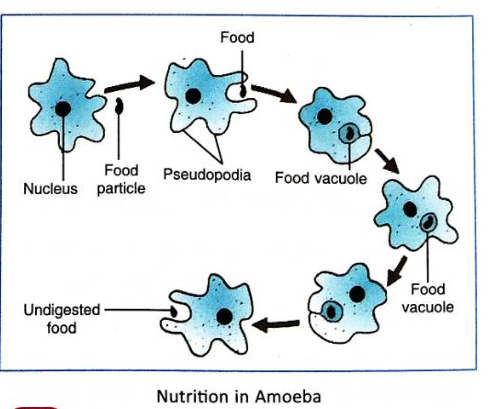
6. Explain ingestion of food in Amoeba, through a diagram.
Amoeba is a single-celled organism that feeds by holozoic nutrition. It captures food with the help of temporary finger-like projections called pseudopodia or false feet. The pseudopodia surround the food particle and form a food vacuole around it. Digestive juices act on the food inside the vacuole and convert it into simpler substances. The useful nutrients are absorbed, and the undigested waste is thrown out of the body.
Class 7th Sceince chapter 1DAV Class 8 SST Chapter 7 – Human Resource Solutions | DAVSolutions
Home: Tata Dav S.St solutionsAlso Read: Class 8th Social science:DAV Class 8 SST Solutions, Notes, MCQs & PDFs
Class Sixth Science :Class 6th