Also Read: Class 7 Science Chapter 1 Nutrition in Living Organisms – Plants Solutions | Tata DAV Living Science
Chemical Substances and Processes Class 7 DAV Chapter 3 Solutions, Notes, Questions & Answers
Acids, Bases and Salts Class 7 DAV Chapter 4 Solutions, Notes, Questions & Answers
Heat Class 7 DAV Science Chapter 5 Solutions, Notes, Questions & Answers
Class 7 Science Chapter 6 Time and Motion DAV Book Solutions | Complete Questions & Answers
A. Fill in the blanks
- The process by which food is broken down to release energy is called respiration.
- Tiny pores present on the surface of leaves are called stomata.
- The respiratory carrier present in blood is haemoglobin.
- Small openings present on the branches of plants are called lenticels.
- Alcohol is produced during fermentation of yeast.
B. Match the following
| Column A | Column B |
|---|---|
| 1. Lactic acid | (c) Muscle cramps |
| 2. Stomata | (a) Transpiration |
| 3. Respiratory carrier | (e) Haemoglobin |
| 4. Lenticels | (b) Pores on branches |
| 5. Alcohol | (d) Fermentation of yeast |
C. Tick (✓) the correct option
1. Respiration helps in—
✅ obtaining energy
2. Stomata perform the function of—
✅ exchange of gases
3. The process represented by the following equation:
glucose+oxygen→carbon dioxide+water+energy
✅ is aerobic respiration
4. To survive, plant roots need—
✅ oxygen
5. Earthworms and leeches respire through their—
✅ skin
D. Answer the following questions in brief
1. Define respiration. Name the two types of respiration.
Respiration is the process by which living organisms break down food to release energy needed for carrying out life activities.
During respiration, oxygen is usually used to break down glucose, and energy is released for growth, movement and other body functions.
Two types of respiration are:
- Aerobic respiration – takes place in the presence of oxygen.
- Anaerobic respiration – takes place in the absence of oxygen.
Example of anaerobic respiration:
- Fermentation in yeast
- Muscle cells during heavy exercise
2. Name the respiratory organ of the following:
(a) Crab
Gills
(b) Man
Lungs
(c) Leech
Skin
(d) An insect
Trachea
Different organisms have different respiratory organs according to their habitat and body structure.
3. Define transpiration.
Transpiration is the process by which plants lose excess water in the form of water vapour through tiny pores called stomata present on leaves.
Importance of transpiration:
- Helps in cooling the plant
- Helps in the upward movement of water and minerals
- Maintains water balance in plants
Plants continuously release water vapour into the atmosphere through this process.
4. Define the term ‘breathing rate’.
Breathing rate is the number of breaths taken by a person in one minute.
One complete breath includes:
- inhalation (breathing in)
- exhalation (breathing out)
Example:
A normal adult at rest breathes about 15–18 times per minute.
Breathing rate increases during exercise because the body needs more oxygen.
5. Name the body organs which help lungs during the process of breathing.
The organs that help the lungs during breathing are:
- Rib cage
- Diaphragm
Their role:
- The rib cage moves upward and outward during inhalation.
- The diaphragm contracts and flattens to increase space in the chest cavity.
These movements help air enter and leave the lungs easily.
6. Why do we need to breathe out carbon dioxide?
Carbon dioxide is produced in our body during respiration as a waste product.
If carbon dioxide remains inside the body in excess amount, it can become harmful and disturb normal body functions.
Therefore, we breathe out carbon dioxide to:
- remove waste gases,
- maintain proper balance of gases in the body, and
- keep the body healthy.
Breathing out carbon dioxide is an important part of respiration that helps our body function properly.
E. Answer the following questions
1. Why do we get muscle cramps after heavy exercise?
During heavy exercise, our muscles need a large amount of energy. Sometimes the oxygen supplied to the muscles becomes insufficient. In such a condition, the muscles start breaking down glucose without oxygen. This process is called anaerobic respiration.
During anaerobic respiration, lactic acid is formed in the muscles.
The accumulation of lactic acid causes pain and muscle cramps.
Important point:
After taking rest, extra oxygen reaches the muscles and helps in breaking down the lactic acid. As a result, the cramps gradually disappear.
2. Why does a potted plant die when overwatered?
Plant roots need oxygen for respiration. The air spaces present in the soil contain oxygen which roots absorb.
When a plant is overwatered:
- water fills all the air spaces in the soil,
- roots do not get enough oxygen,
- respiration in roots gets affected.
As a result, the roots may rot and the plant gradually dies.
Thus, excessive watering is harmful because roots also need air to survive.
3. Where are stomata found in a plant? State their function.
Stomata are tiny pores present mainly on the lower surface of leaves. They are surrounded by guard cells.
Functions of stomata:
(i) Exchange of gases
Stomata allow carbon dioxide to enter the plant and oxygen to move out during photosynthesis and respiration.
(ii) Transpiration
They help in the removal of excess water from the plant in the form of water vapour.
Importance:
- Helps plants breathe
- Maintains water balance
- Helps in cooling the plant
Thus, stomata play a very important role in the life processes of plants.
4. How is oxygen transported from lungs to the other parts of the body?
When we inhale air, oxygen enters the lungs. Inside the lungs, oxygen passes into the blood through tiny air sacs called alveoli.
The blood contains a red pigment called haemoglobin present in red blood cells.
Haemoglobin combines with oxygen and carries it to all parts of the body through blood circulation.
Process:
- Oxygen enters lungs.
- Oxygen mixes with blood.
- Haemoglobin carries oxygen.
- Blood transports oxygen to body cells.
The cells use this oxygen during respiration to release energy from food.
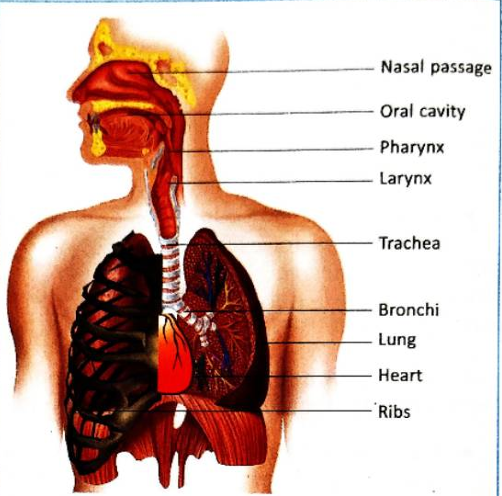
5. Draw a neat, well-labelled diagram of the human respiratory system.
6. Describe an activity to show that exhaled air contains carbon dioxide.
Aim:
To show that exhaled air contains carbon dioxide.
Materials required:
- A test tube or glass
- Fresh lime water
- Straw
Procedure:
- Take some fresh lime water in a test tube.
- Put one end of the straw into the lime water.
- Blow air gently through the other end of the straw for some time.
Observation:
The lime water turns milky.
Reason:
Carbon dioxide present in exhaled air reacts with lime water to form calcium carbonate, which makes the solution milky.
Equation:
Ca(OH)2+CO2→CaCO3+H2O
Conclusion:
Exhaled air contains carbon dioxide.
7. Describe the changes that take place in:
(i) Around the rib cage
(ii) Diaphragm during breathing.
(i) Changes around the rib cage
During inhalation:
- Ribs move upward and outward.
- Chest cavity becomes larger.
- Lungs expand and air enters.
During exhalation:
- Ribs move downward and inward.
- Chest cavity becomes smaller.
- Air is pushed out of the lungs.
(ii) Changes in diaphragm
During inhalation:
- Diaphragm contracts and becomes flat.
- Space in the chest cavity increases.
- Air enters the lungs.
During exhalation:
- Diaphragm relaxes and becomes dome-shaped.
- Space in the chest cavity decreases.
- Air moves out of the lungs.
These movements of the rib cage and diaphragm help us breathe continuously