A. Fill in the blanks
- A good fuel should have its ignition temperature above the room temperature.
- Burning of cow dung cakes is an example of slow combustion.
- The innermost zone of a candle flame is the coldest.
- The non-luminous zone of a candle flame is the outermost part of the flame.
- During incomplete combustion of a fuel, carbon monoxide gas is formed.
B. State True or False
- Coal is an inflammable fuel. — False
- The outermost part of a candle flame contains unburnt carbon particles. — False
- The heat produced by burning completely one kilogram of a given fuel is known as the efficiency of that fuel. — False
- All solid fuels have a higher calorific value than liquid and gaseous fuels. — False
- Sulphur dioxide gas produced during combustion of fossil fuels causes acid rain. — True
C. Tick (✓) the correct option
1. An example of a non-combustible substance is—
✅ Iron
2. A fuel starts burning only when it is heated to—
✅ Its ignition temperature
3. The highest temperature zone of a candle flame is its—
✅ Blue zone
4. The amount of heat produced on complete burning of 10 kg of a given fuel in pure oxygen equals H kJ. The calorific value of that fuel would equal—
✅ (0.1 H) kJ/kg
5. The gas produced due to incomplete combustion of carbon fuels is—
✅ Carbon monoxide
D. Answer the following questions in brief
Chapter: Combustion and Flame (DAV Class 8 Science)
1. Define the term ‘combustible material’. Give two examples of combustible materials.
Answer:
A combustible material is a substance that burns in the presence of oxygen and produces heat and light.
Examples:
- Wood
- Coal
2. State the three conditions that are needed for combustion to take place.
Answer:
The three essential conditions for combustion are:
- A combustible substance (fuel) must be present.
- A supporter of combustion (oxygen/air) must be available.
- The fuel must be heated to its ignition temperature.
3. State the condition under which ‘slow combustion’ of a material takes place.
Answer:
Slow combustion occurs when a combustible material reacts with oxygen slowly at ordinary (room) temperature, producing heat gradually without a flame or explosion.
Example: Burning of cow dung cakes or rusting of iron (slow oxidation).
4. Define ‘calorific value of a fuel’.
Answer:
The calorific value of a fuel is the amount of heat energy produced when 1 kilogram of the fuel is completely burnt in oxygen.
It is expressed in kilojoules per kilogram (kJ/kg).
5. State any two characteristics of an ideal fuel.
Answer:
Any two characteristics of an ideal fuel are:
- It has a high calorific value, producing a large amount of heat.
- It burns cleanly without producing smoke or harmful gases.
Other characteristics (for reference): It should be inexpensive, easily available, easy to store and transport, and have a moderate ignition temperature.
6. Why is water not used in controlling electrical fires?
Answer:
Water is not used to extinguish electrical fires because it is a good conductor of electricity. Pouring water on an electrical fire can cause electric shock and may spread the fire further.
Instead, carbon dioxide (CO₂) or dry chemical powder fire extinguishers are used to put out electrical fires.
E. Answer the following questions
Chapter: Combustion and Flame (DAV Class 8 Science)
1. Draw a diagram showing the different zones of a candle flame. Label the zone which contains:
(a) Unburnt vapours of wax
(b) Unburnt carbon particles
Answer:
Diagram of a Candle Flame
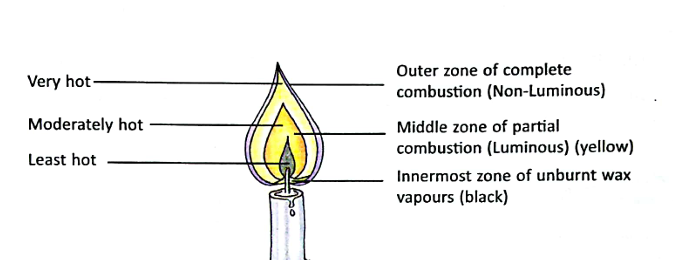
Labels:
- (a) Inner (dark) zone – Contains unburnt vapours of wax. It is the coolest part of the flame because combustion has not yet started completely.
- (b) Middle (yellow luminous) zone – Contains unburnt carbon particles. These particles glow due to high temperature and give the flame its yellow colour.
Explanation:
A candle flame has three distinct zones:
- Inner dark zone – Contains unburnt wax vapours and has the lowest temperature.
- Middle luminous (yellow) zone – Contains partially burnt carbon particles. Incomplete combustion takes place here, making it bright and yellow.
- Outer non-luminous (blue) zone – Oxygen is available in sufficient amount, so complete combustion occurs. It is the hottest part of the flame.
2. Calorific value of wood is 18,000 kJ/kg. How much wood is required to produce 360,000 kJ of heat energy?
Answer:
Given:
- Calorific value of wood = 18,000 kJ/kg
- Heat energy required = 360,000 kJ
Formula:Mass of wood=Calorific ValueHeat Energy Required
Calculation:Mass of wood=18000360000 =20 kg
Answer:
20 kg of wood is required to produce 360,000 kJ of heat energy.
3. Why are gaseous fuels considered better than liquid or solid fuels?
Answer:
Gaseous fuels are considered better than solid and liquid fuels because they burn more efficiently and are less harmful to the environment.
Reasons:
- They burn completely, producing a large amount of heat.
- They produce very little smoke, soot, or ash, making them cleaner fuels.
- They have a high calorific value, so they provide more heat per unit mass.
- They are easy to transport and distribute through pipelines.
- They can be ignited and controlled easily, making them convenient for domestic and industrial use.
- They cause less air pollution compared to coal and wood.
Examples: LPG, CNG, and natural gas.
4. Why do we say that ‘burning of fuels’ can cause ‘health hazards’?
Answer:
The burning of fuels releases several harmful gases and fine particles into the atmosphere. These pollutants affect both human health and the environment.
Health hazards caused by burning of fuels:
- Carbon monoxide (CO) is produced during incomplete combustion. It is a poisonous gas that reduces the oxygen-carrying capacity of blood and can cause suffocation.
- Sulphur dioxide (SO₂) and nitrogen oxides (NOₓ) irritate the eyes and respiratory system and contribute to acid rain.
- Smoke and tiny suspended particles can enter the lungs, leading to asthma, bronchitis, coughing, and other respiratory diseases.
- Continuous exposure to polluted air may increase the risk of heart and lung diseases.
- Excessive burning of fossil fuels also releases carbon dioxide (CO₂), which contributes to global warming and climate change, indirectly affecting human health.
Conclusion:
Therefore, the burning of fuels can be harmful because it releases poisonous gases and pollutants that cause respiratory problems, environmental pollution, and long-term health hazards.
DAV Class 8 Science Chapter 7 – Combustion and Flame Notes
Quick Revision Notes (Based on DAV Book)
1. Combustion
- Combustion is the process of burning a combustible substance in the presence of oxygen.
- During combustion, heat and light energy are released.
Example: Burning of wood, coal, LPG, candle wax.
2. Fuels
A fuel is a substance that burns to produce heat energy.
Types of Fuels
- Solid Fuels: Wood, coal, cow dung cakes
- Liquid Fuels: Petrol, diesel, kerosene
- Gaseous Fuels: LPG, CNG, natural gas
3. Oxygen – Supporter of Combustion
- Oxygen present in air supports combustion.
- It is called the supporter of combustion because fuels cannot burn without oxygen.
4. Ignition Temperature
Ignition temperature is the lowest temperature at which a combustible substance catches fire.
Examples
- Paper has a low ignition temperature.
- Coal has a higher ignition temperature than paper.
5. Conditions Necessary for Combustion
Three conditions are essential for combustion:
- Presence of a combustible substance (fuel)
- Oxygen (air) must be available.
- The fuel must be heated above its ignition temperature.
If any one of these conditions is absent, combustion cannot occur.
6. Types of Combustion
(i) Slow Combustion
- Takes place slowly.
- Produces heat gradually.
- Usually no flame is produced.
Example: Burning of cow dung cakes.
(ii) Rapid Combustion
- Burning takes place quickly after applying a flame.
Example: Burning of LPG.
(iii) Spontaneous Combustion
- A substance catches fire on its own without any external flame.
Example: White phosphorus.
(iv) Explosive Combustion
- Burning occurs suddenly with heat, light, sound and large amount of gases.
Example: Firecrackers.
7. Zones of a Candle Flame
A candle flame has three zones.
| Zone | Colour | Characteristics |
|---|---|---|
| Inner (Dark) Zone | Dark | Contains unburnt wax vapours and is the coolest part. |
| Middle (Luminous) Zone | Yellow | Contains unburnt carbon particles. Incomplete combustion takes place here. |
| Outer (Non-luminous) Zone | Blue | Complete combustion occurs. It is the hottest zone. |
Remember
- Coolest Zone → Inner Zone
- Brightest Zone → Middle Zone
- Hottest Zone → Outer Zone
8. Why Are the Three Zones Different?
The three zones differ because the extent of combustion of wax vapours is different in each zone.
- Inner zone → No combustion
- Middle zone → Incomplete combustion
- Outer zone → Complete combustion
9. Calorific Value
The calorific value of a fuel is the amount of heat produced by complete burning of 1 kg of the fuel in pure oxygen.
Unit
kJ/kg (Kilojoule per kilogram)
Higher calorific value means the fuel produces more heat.
10. Characteristics of an Ideal Fuel
An ideal fuel should:
- Be cheap.
- Be easily available.
- Burn easily.
- Have a high calorific value.
- Have ignition temperature above room temperature.
- Be easy to transport and store.
- Produce very little smoke or ash.
- Not pollute the environment.
11. Why Are Gaseous Fuels Better?
Gaseous fuels are considered better because they:
- Have a high calorific value.
- Burn completely.
- Produce very little smoke and ash.
- Cause less pollution.
- Are easy to transport through pipelines.
- Have low ignition temperature.
Examples
- LPG
- CNG
- Natural Gas
12. Harmful Effects of Burning Fuels
Burning fuels releases harmful gases that pollute the environment.
Effects
- Causes air pollution.
- Leads to acid rain.
- Increases global warming.
- Causes respiratory diseases.
- Damages plants, animals and buildings.
13. Incomplete Combustion
When oxygen supply is insufficient, incomplete combustion occurs.
It produces carbon monoxide (CO), a poisonous gas.
Carbon Monoxide
- Colourless
- Odourless
- Highly poisonous
- Reduces oxygen supply to the body
14. Importance of CNG
CNG should be encouraged because it:
- Burns cleanly.
- Produces less smoke.
- Causes less pollution.
- Has a high calorific value.
- Is environment-friendly.
⭐ Key Terms
| Term | Definition |
|---|---|
| Combustion | Burning of a fuel in the presence of oxygen. |
| Fuel | A substance that burns to produce heat energy. |
| Combustible Substance | A substance that can burn. |
| Ignition Temperature | Lowest temperature at which a substance catches fire. |
| Calorific Value | Heat produced by burning 1 kg of fuel completely. |
| Supporter of Combustion | Oxygen. |
| Complete Combustion | Burning in sufficient oxygen producing carbon dioxide and water. |
| Incomplete Combustion | Burning in limited oxygen producing carbon monoxide. |
also read: Home: Tata Dav S.St solutions
CLASS 7 Science and Social Scince
Class 6th Science